

On day one, your document extraction API looks impressive. The demo runs smoothly, fields are extracted correctly, and accuracy numbers look promising.
By day 90, things look different.
New vendors bring unfamiliar invoice formats. Loan documents contain unexpected fields. Some layouts confuse the model. Your team starts correcting the same errors, sometimes on hundreds of documents. Shouldn't the system have learned from the first correction?
That's the promise of continuous learning. Many document AI vendors now use the term, but fewer explain what happens to your corrections or who benefits from them.
In this blog, we'll explain how continuous learning works, why static document AI stops improving, how automatic prompt tuning uses corrections, and why customer-specific learning matters for accuracy and data control.
What Continuous Learning Actually Means
Continuous learning means your document AI system improves by learning from corrections made during everyday processing.
Imagine teaching a new employee to process invoices. The first time they confuse an invoice date with a due date, you explain the difference. The next time they see a similar invoice, they remember your instruction. You wouldn't expect to repeat the same lesson every morning.
Document AI should work the same way.
When a reviewer corrects an extracted field, that correction should help the system handle similar documents in the future. The improvement happens within the existing workflow, without starting a separate retraining project, raising a vendor ticket, or waiting for the next model release.
This is different from a static extraction model that follows fixed instructions or a vendor that releases model updates every quarter.
Corrections are among the most valuable data your document processing pipeline produces. They show the system exactly where its understanding failed and what the correct answer should be.
Why Static Document AI Plateaus
An extraction model can perform well during testing and still struggle after deployment. The problem is that real business documents rarely follow the same patterns forever.
Three factors explain why accuracy often stops improving.
- Document formats change. Vendors update invoice layouts, banks change statement formats, and new document types enter your workflow. A fixed model or prompt cannot anticipate every variation.
- Every business follows different conventions. One company might classify a field as "Invoice Reference," while another calls it "Document Number." Your extraction logic needs to understand what these fields mean in your workflow.
- Corrections don't feed back into the system. Without a learning loop, reviewers keep fixing familiar errors. Humans become permanent error-catchers instead of helping the system improve.
There's another issue for developers. A document automation API without a correction UI solves only half the problem. It extracts data but gives users limited control over what happens when the output is wrong.
A correction UI lets customers review and adjust the data sent downstream, whether that's a knowledge base, an embedding pipeline, a RAG application, or another business system.
How Continuous Learning Works, Step by Step
Continuous learning connects document extraction, human review, and system improvement in one workflow. Each correction gives the system feedback it can use on similar documents.
Here's how the loop works:
- Extract: The document processing API reads the document, extracts fields, and assigns confidence scores to the results.
- Flag: Fields with low confidence or failed validation checks are sent for human review.
- Correct: A reviewer opens the correction UI, checks the original document, and fixes the incorrect values.
- Learn: The system uses those corrections as feedback to improve its extraction instructions.
- Apply: Future documents with similar patterns benefit from the updated instructions.
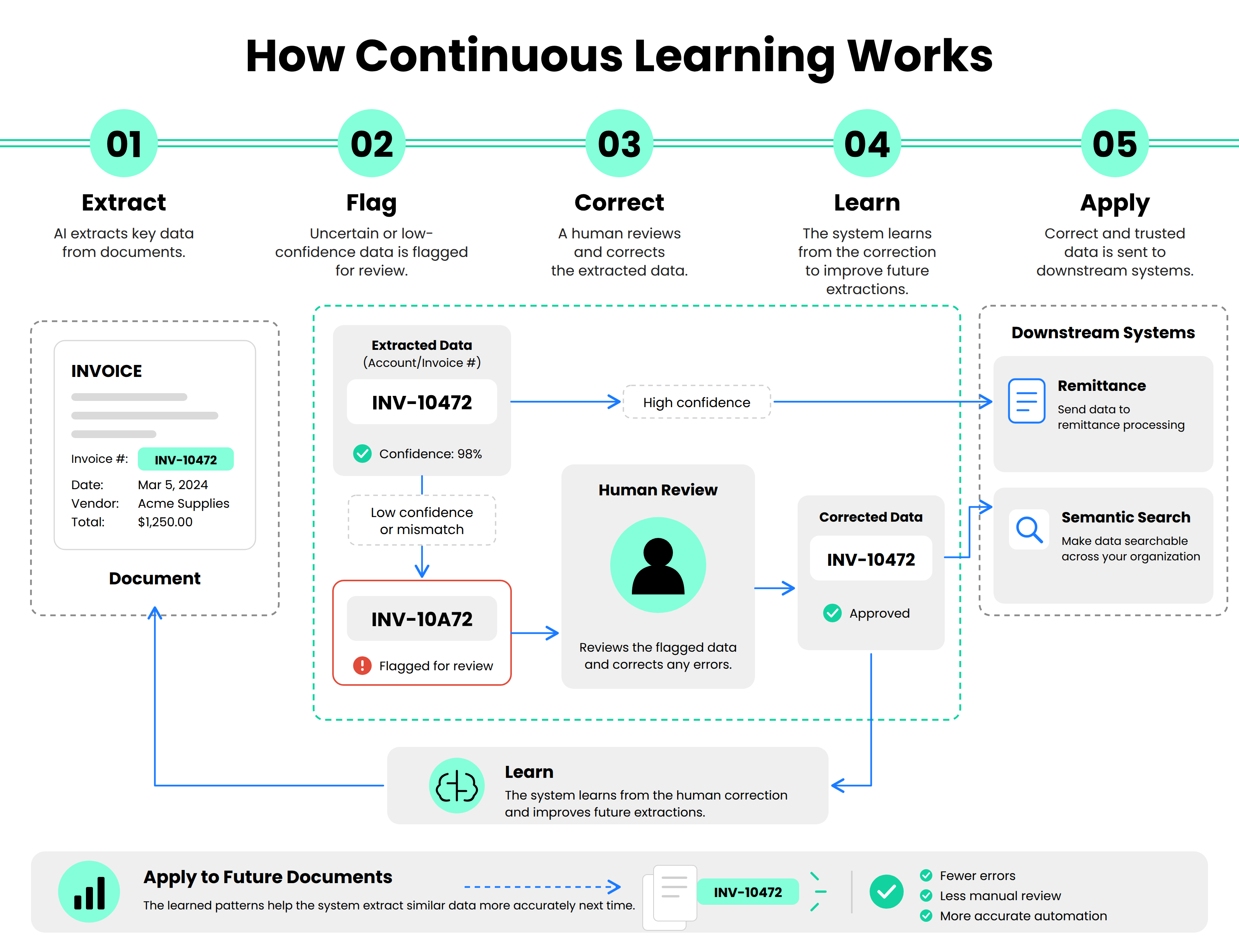
The important distinction is the reviewer's role. A human isn't simply correcting bad data. They're teaching the system how to avoid repeating the mistake.
Auto Prompt Tuning: The Engine Behind the Loop
Traditional model improvement often involves collecting labeled data, preparing a training dataset, and retraining or fine-tuning a model. Auto prompt tuning takes a different approach.
Instead of rebuilding the model, it improves the instructions used to extract information from documents.
Think of a GPS that keeps taking you to the wrong entrance of an office building. You don't need to rebuild the GPS. You need to correct the destination instructions so it directs you to the right entrance next time. Prompt tuning follows a similar principle.
For example, suppose an extraction model repeatedly mistakes "Ship Date" for "Invoice Date." A corrected example can help refine the prompt so future extractions distinguish between those fields.
Manually rewriting prompts for every vendor and document variation doesn't scale. Auto prompt tuning uses correction feedback to identify recurring mistakes and refine extraction instructions.
However, this approach has limits.
- Missing context: If the correct answer isn't present in the document or available context, changing the prompt may not solve the problem.
- Sparse fields: Fields that appear only occasionally provide fewer examples for learning.
- Limited correction data: A handful of corrections may not reveal a reliable pattern.
Auto prompt tuning works best when corrections provide clear examples that the system can apply to future documents.
Your Own Adapted Layer, Per Customer
Continuous learning becomes more valuable when each customer controls what the system learns. A shared base model can support many businesses while keeping their document-specific instructions separate. This is where a customer-specific adapted layer comes in.
The adapted layer combines the customer's extraction schema, auto-tuned prompts, learned examples, and field-level rules. Consider two companies processing invoices.
Company A frequently receives invoices with "Net 30" payment terms. Company B mainly processes invoices marked "Due upon receipt."
Both use the same underlying extraction model, but their adapted layers learn different document patterns and conventions. Corrections from Company A improve its own extraction instructions without changing Company B's behavior.
The base model is shared. What the system learns about your documents is not.
Why Corrections Shouldn’t Leave Your Account
Every document correction contains more information than a simple right or wrong answer. It can reveal real business data, document conventions, and the rules your organization uses to interpret information. That's why the location and ownership of correction data matter.
Consider an invoice correction. A reviewer might change an extracted payment amount, supplier name, or bank account number. In a mortgage workflow, a correction could involve borrower income, loan details, or information from financial records.
These are real values from real business documents.
If corrections are pooled across customers for shared model improvement, several questions arise:
- Data exposure: What information gets transferred into the shared learning process, and how is it protected?
- Cross-customer learning: Could patterns learned from your documents influence the results another customer receives?
- Compliance: Does the correction process follow your organization's data handling, retention, and access requirements?
- Control: Can you inspect, manage, or remove correction data used for learning?
Pooled learning doesn't automatically mean sensitive data is exposed. Providers can use safeguards such as anonymization and data separation. But customers should understand exactly how those safeguards work.
One question makes this easier to evaluate: "Do my corrections improve a model that other customers use?"
The answer should explain where correction data is stored, how it influences future extraction, and whether customer information is used for shared training. With isolated learning, each customer's corrections improve its own adapted layer.
The benefit goes beyond privacy. Your organization builds a growing set of extraction knowledge based on its actual documents, without sharing those improvements across customer accounts.
How IDPForge Does It: Learning Inside the Correction UI
Continuous learning works best when it becomes part of document processing rather than a separate technical project.
IDP Forge brings extraction review, correction, and customer-specific learning into the same workflow.
When a document enters the pipeline, the system extracts the required fields and identifies values that need attention. Those fields appear in the Correction UI's Exceptions queue, where reviewers can inspect and fix them. The reviewer doesn't need to inspect every extracted value. They can focus on the fields flagged for review.
Once corrected, the feedback becomes part of that customer's adapted learning layer, helping refine future extraction behavior.
IDP Forge also preserves the original extracted value alongside the corrected value. This creates a record of what the system produced, what the reviewer changed, and where the extraction needed improvement. That record supports both auditability and learning.
And because the correction process is built into the extraction workflow, teams don't need to organize a separate model retraining exercise or involve a data science team each time they identify an error.
Watching Accuracy Climb with Every Correction
The real value of continuous learning appears over time.
Imagine your team processes 5,000 invoices every month. A particular vendor uses an unusual layout that repeatedly causes the extraction model to confuse the purchase order number with the invoice number.
Without continuous learning, reviewers correct the same issue every month. Even if the model extracts most fields correctly, that recurring exception creates unnecessary work. With a learning loop, those corrections become examples that can improve how the system handles that vendor's invoices. As the system learns recurring patterns, fewer similar fields should require review.
That improvement creates three practical benefits:
- Fewer repeated exceptions: Reviewers spend less time correcting errors the system has already encountered.
- Lower manual review volume: Better extraction accuracy can reduce the number of documents and fields that need human attention.
- More time for meaningful exceptions: Teams can focus on unfamiliar formats, missing information, and validation failures rather than routine corrections.
However, improvement isn't guaranteed after every correction. Results depend on the quality of feedback, the number of similar examples, and whether the system has enough information to learn a consistent pattern. Teams should measure progress through field-level accuracy, exception rates, and correction frequency across recurring document types.
For example, if a particular invoice format generates 100 exceptions in the first month and 35 in the third month, that's a measurable improvement worth investigating. The goal isn't to eliminate human review. It's to make review progressively more useful.
Over time, the team should spend less effort fixing familiar mistakes and more time monitoring extraction quality and handling genuinely new exceptions.
Conclusion
A document AI system shouldn't make your team correct the same mistake indefinitely. Continuous learning turns everyday corrections into feedback that helps improve future extraction. Auto prompt tuning can make that improvement possible without requiring constant manual prompt changes or full model retraining.
But accuracy is only part of the equation.
Where those corrections go, who can use them, and whether the learning stays within your account matter just as much. IDP Forge brings correction and customer-specific learning into the document processing workflow, so your extraction knowledge grows with your business.
Because learning that doesn't stay with you isn't really yours.